Dossier Enigmasaur by Wildcard
At Studio Wildcard, the signs are currently pointing toward mythological innovations. While survivors explore a "new" vertical dimension of the struggle for survival with the floating island world of Dragontopia , the latest Community Crunch 528 now brings clarity as to what the Enigmasaur will be. Release is scheduled for November 6, 2026.
Dragontopia: Floating Island Worlds and Dragon Hierarchies
With the announcement of the Dragontopia DLC, Studio Wildcard shifts the gameplay into a vertical ecosystem of floating islands above the clouds. Instead of classic landscapes, the focus here is on a heavily fragmented sky world. The setting revolves around the legacy of a bygone order of dragon riders and introduces several specialized creatures: in addition to titanic colossi and wind-dancing mounts, the official description announces four-winged hunters, two-headed hybrids with combined breath attacks, and smaller shoulder-mounted companion dragons. The gameplay mechanics are complemented by thematic building sets, incubator backpacks, and new alchemy stations.
However, the visual appearance of the initial dragon models sparked divided opinions within the community. The anatomical similarity to animated films such as DreamWorks' "How to Train Your Dragon" was frequently criticized—particularly regarding facial features that portions of the player base perceived as too soft for ARK's customary aesthetic. The modding scene has already responded to this: through mods such as Umbra & Lumina Reforged, alternative textures are available that give the beasts a more reptilian texture. It remains to be seen whether Wildcard itself will integrate additional visual variants before release.
From a functional standpoint, however, the planned Dragon Skill Tree system has been received positively. Specializing individual creatures via dedicated skill trees creates additional endgame progression. From a balancing perspective, though, the system poses risks: if an isolated talent tree is developed for every creature, maintenance effort increases exponentially. Grouping by creature classes or archetypes, combined with mutually exclusive developmental paths, would be the more stable long-term solution—an approach that could also set the direction for the architecture of ARK 2.
The Enigmasaur: Mechanics and Abilities of the Shapeshifter
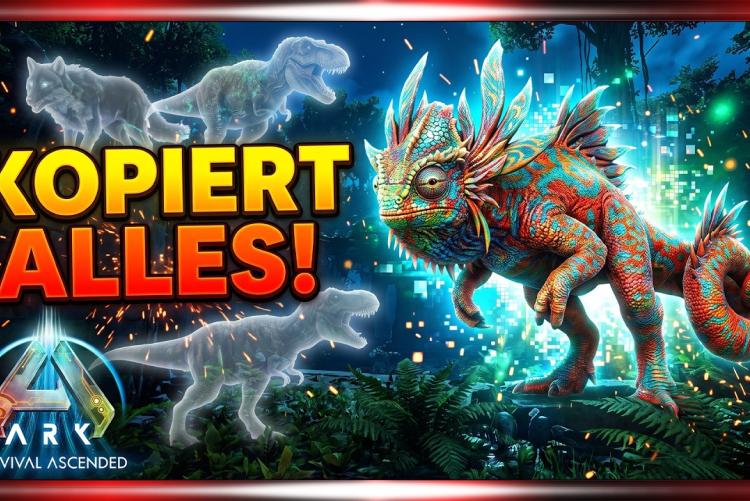
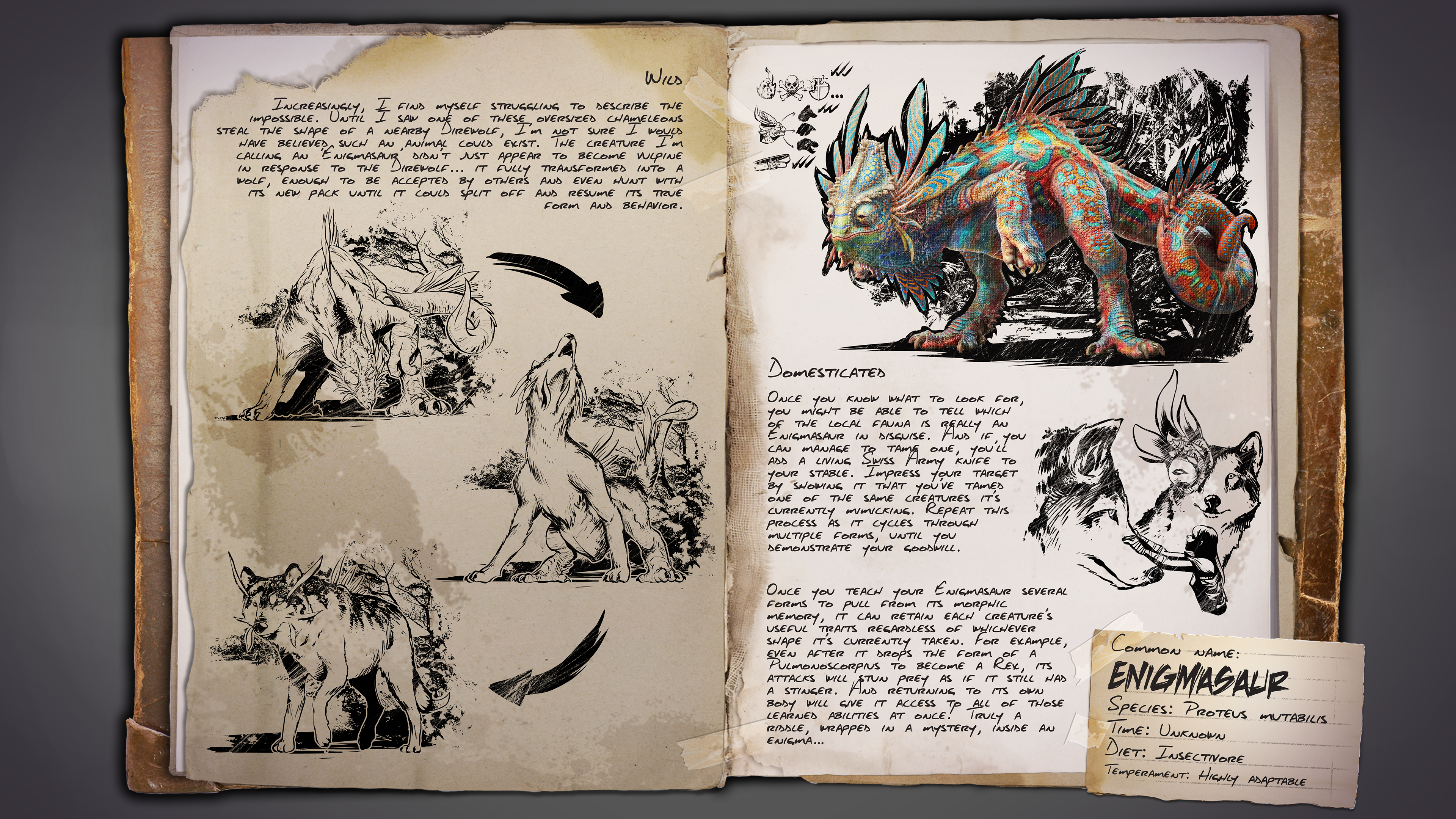
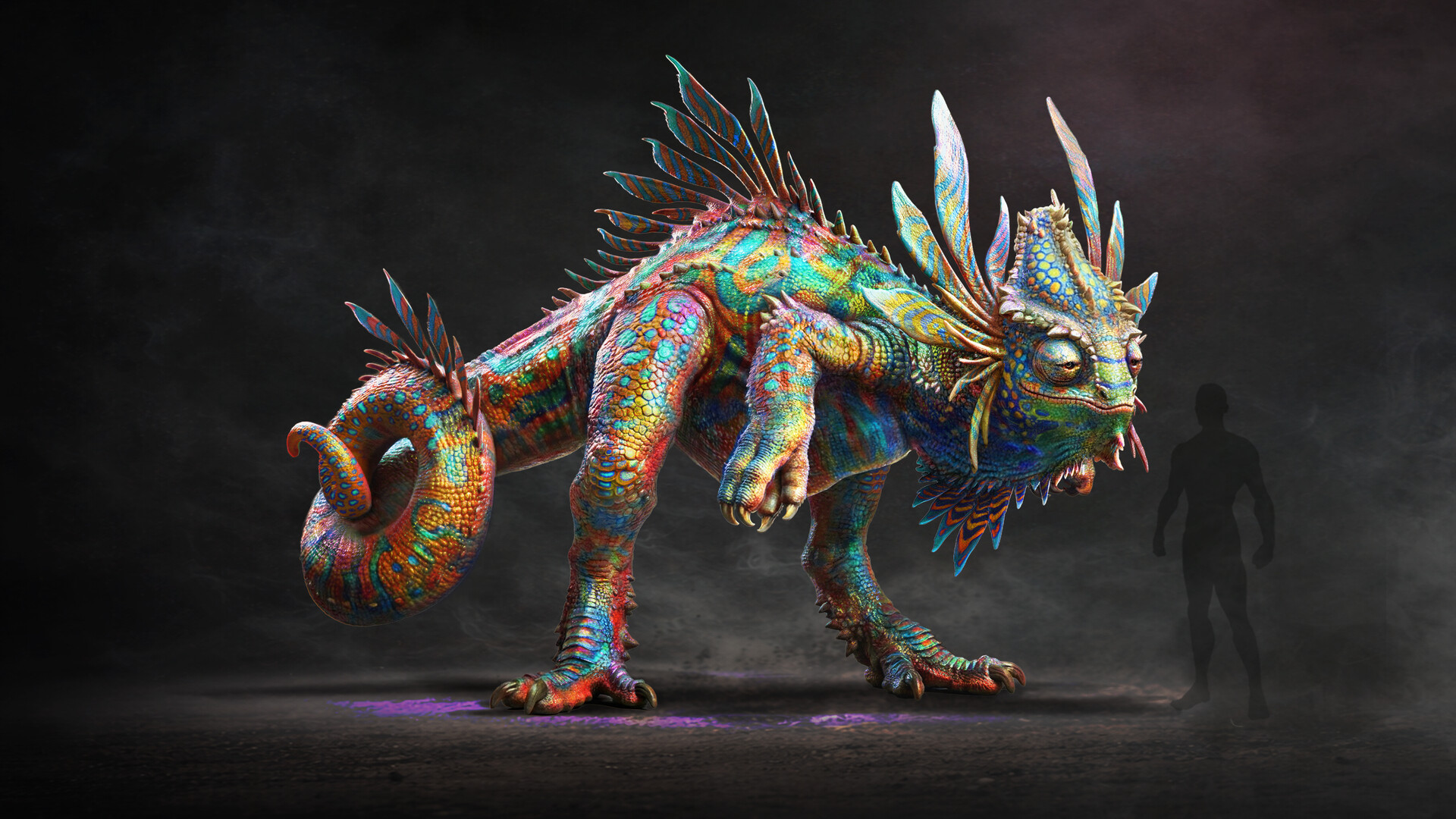
In Community Crunch 528, Studio Wildcard officially introduced the Enigmasaur (Proteus mutabilis). According to the dossier, it is a large, insectivorous reptile with chameleon-like traits, whose core mechanic is based on a complete physical transformation. The animal does not merely camouflage itself visually, but takes on the form of other species, joins their packs, and adopts their typical behavior.
Its unique feature lies in what is known as morphic memory: the Enigmasaur permanently stores specific traits of imitated species and can transfer them into other forms. As an official example, Wildcard cites the combination of a Tyrannosaurus's form and the tranquilizing sting of a scorpion (Pulmonoscorpius). In its original reptilian form, it will ultimately be able to draw upon all abilities learned up to that point simultaneously.
The taming process deviates from traditional knockout or passive methods. According to the dossier, the creature's trust must be built up gradually by the survivor presenting the Enigmasaur with a tamed specimen of the exact species it is mimicking at that moment. Since the creature cycles through multiple forms during the encounter, this interaction must be repeated multiple times with matching companion creatures.
Speculations and gameplay classification: Since the taming process demands an immediate response to shifting creature forms, it can be assumed that carrying cryopods in one's inventory is a mandatory prerequisite for flexibly deploying the required creatures. What remains unclear and the subject of current speculation is how many ability slots the morphic memory can manage and whether particularly powerful creatures—namely Alpha creatures or boss enemies—are excluded from DNA assimilation for game balancing reasons.
Scientific Context and Mythological Origin
Despite the similarity in name, there is no paleontological connection to the actual therizinosaur Enigmosaurus, which lived during the Late Cretaceous period and whose name merely referred to anatomical peculiarities of the pelvic skeleton. The origin of the name in ARK is based on the Greek word for riddle as well as the formal binomen Proteus mutabilis.
The naming directly references two mythological concepts:
- In Greek mythology, the sea god Proteus embodies the fickle power of transformation. According to legends, he tried to evade interrogation by constantly assuming the shape of various beasts of prey and forces of nature; only those who held him fast and endured his transformations received answers. This tale mirrors the mechanic of deliberately mirroring the Enigmasaur across multiple shapeshifts.
- A comparable pattern is found in Norse mythology with the figure of Loki, who repeatedly used animal forms to blend unnoticed into groups or to gain tactical advantages. The combination of these myths of metamorphosis and the Churchill quote in the dossier ("a riddle, wrapped in a mystery, inside an enigma") makes it clear that Wildcard has created a purely fictional creature here that translates classic motifs of metamorphosis into a systemic gameplay element.